Houston clay and your concrete: what's really happening under the slab
The ground under most of Houston swells when it's wet and shrinks when it's dry. Concrete sitting on it moves too. Good concrete work plans for that instead of pretending it won't happen.
The Beaumont clay
Much of Houston sits on the Beaumont Formation, a layer of clay-rich sediments laid down along the old Gulf coast. Geologists and geotechnical engineers have long described its soils as highly expansive: they contain clay minerals in the montmorillonite family that soak up water and swell, then shrink and crack as they dry. Work published through the University of Houston has put roughly a quarter of the Beaumont clays in Houston at moderate-to-high shrink-swell potential and about half at high potential.
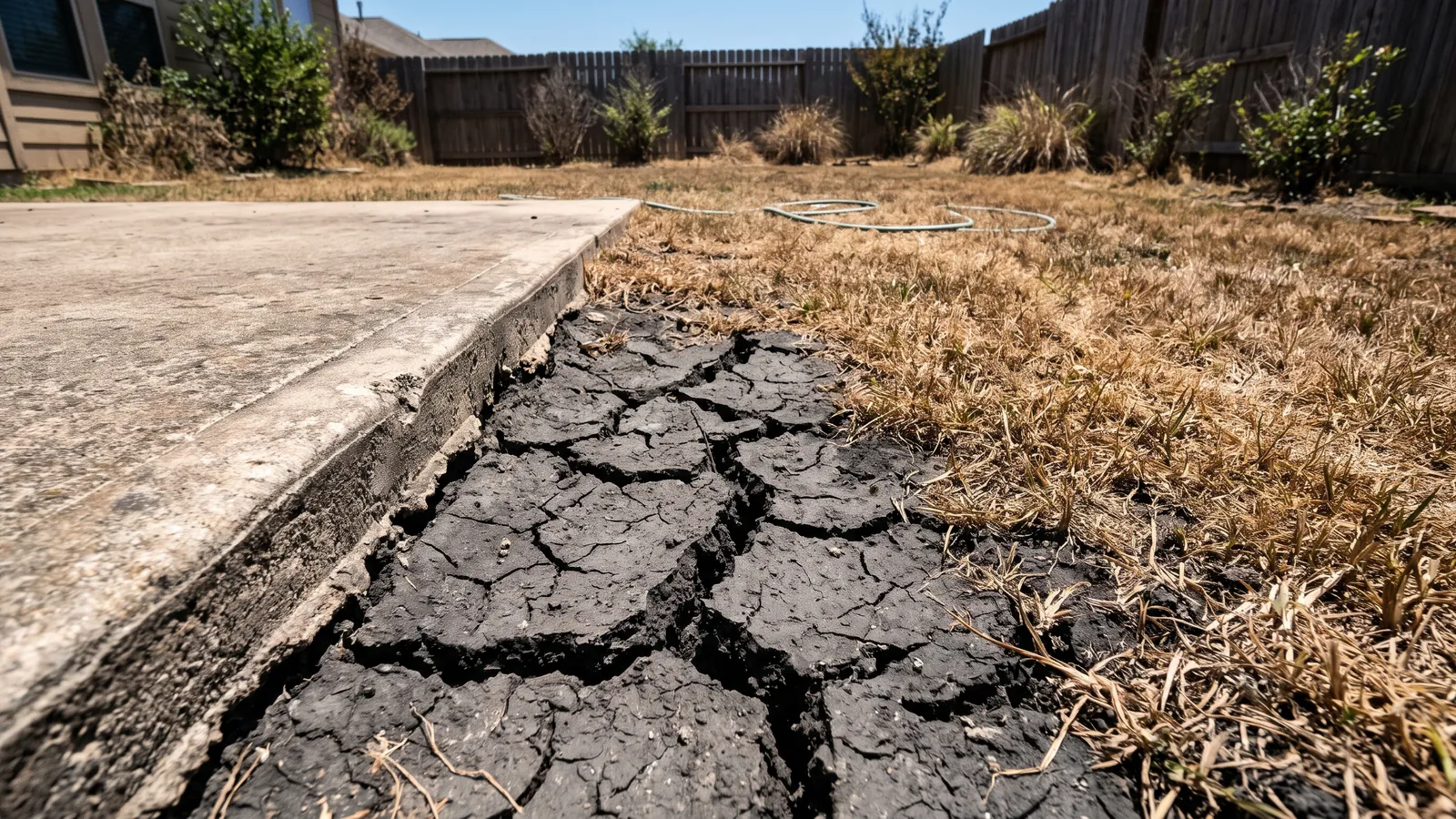
You can see it in a dry August. Wide cracks open in lawns and flower beds, gaps appear along the edge of a patio, and doors in older houses start to stick. After a wet spell the cracks close and the ground swells back. That cycle repeats every year, and hits harder in drought years like 2011.
What it does to concrete
- Edge drop. The soil at a slab's edge dries and shrinks more than the soil in the middle, so edges sag and cracks run in from the sides.
- Uneven support. One part of a driveway shaded by a tree, or watered by a sprinkler, moves differently from the part in full sun, and the slab cracks between them.
- Tree roots. Large trees pull a lot of water out of clay, drying and shrinking the soil near them, and roots can lift slabs directly.
- Washouts. Downspouts and leaks carry soil and base out from under slab edges, leaving voids.
What helps
No flatwork technique stops the clay from moving; house foundations here are engineered for it, often with post-tensioned slabs. For driveways, patios and walks, the goal is to keep the slab moving as one piece and to keep its cracks in the joints.
- Dig to firm soil and remove organic topsoil and soft spots.
- Compacted crushed base for an even, firm bed.
- Steel on chairs so cracked panels stay tied together.
- Thicker slabs where loads are heavy.
- Control joints cut early and spaced for the slab's thickness.
- Water managed at the edges: gutters, downspout extensions, a fall away from the house, and sprinklers that don't soak one side.
What homeowners can do
Keep moisture around slabs and foundations more even through the year. In long dry spells, the soaker-hose watering that many foundation specialists recommend around a house foundation can help the soil near flatwork too, while standing water and downspouts emptying beside a slab do the opposite. Seal cracks once they open so water doesn't reach the base.
A note on foundations: if you're seeing cracked brick, doors that stick, or sloping floors inside the house, call a foundation repair specialist or a structural engineer. That's beyond flatwork.
Questions people ask
Can you stop my driveway from cracking?
Not completely, on Houston clay. We can make it crack where we want, in the joints, and keep panels from breaking apart and sinking.
Should I water my driveway?
No, but even soil moisture nearby helps. Avoid letting sprinklers soak one side and keep downspouts from emptying beside the slab.
Is Houston clay the same everywhere?
No. Soils vary across the metro, and some areas are sandier, particularly toward the north and northwest. A soil report gives the real answer for a specific lot.
Does fiber in the mix help?
Fiber reduces early shrinkage cracking at the surface. It doesn't replace rebar for holding a slab together over moving clay.
Keep reading: Concrete repair · Leveling · Concrete driveways