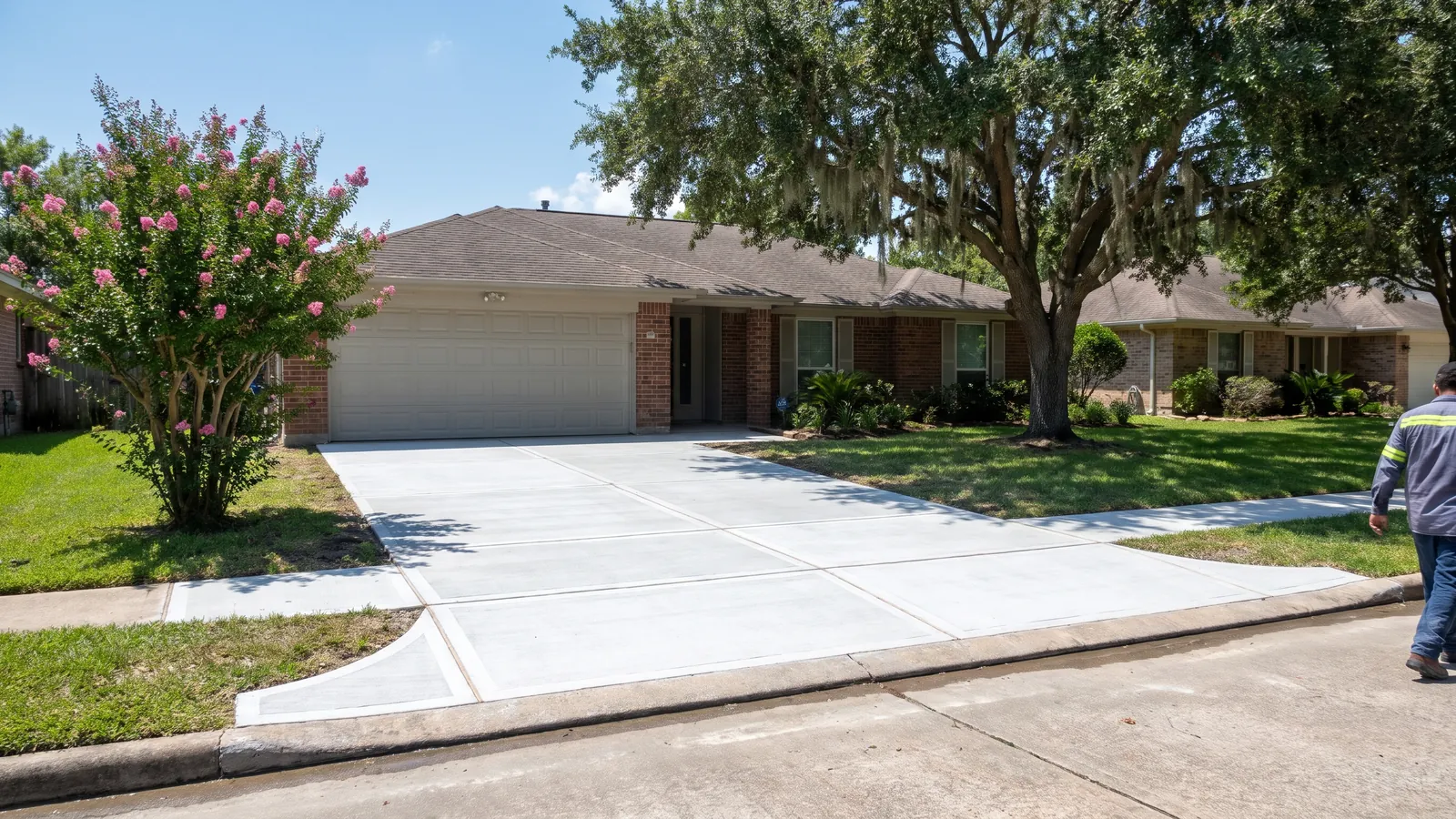
Most driveway calls we get in Houston are replacements: a 1970s or 80s driveway that has broken along the middle, dropped at the street, lifted where a live oak's roots run under it, or settled away from the garage so water stands at the door. Some are new: a widened parking pad, a side drive to a back gate, a slab for a boat or an RV, or the drive on a teardown rebuild in Bellaire or the Heights.
A new driveway starts with the old one coming out, broken up and hauled to a recycler, and then the part nobody photographs. We dig the subgrade down past the dark topsoil and organic layer to firm soil, cut out soft spots, and bring in a crushed base that we spread in lifts and compact. On Houston's expansive clay, the base is not there to stop the soil from moving, because nothing short of an engineered system does that; it is there to give the slab an even, firm bed so it moves as one piece instead of rocking on a soft spot.
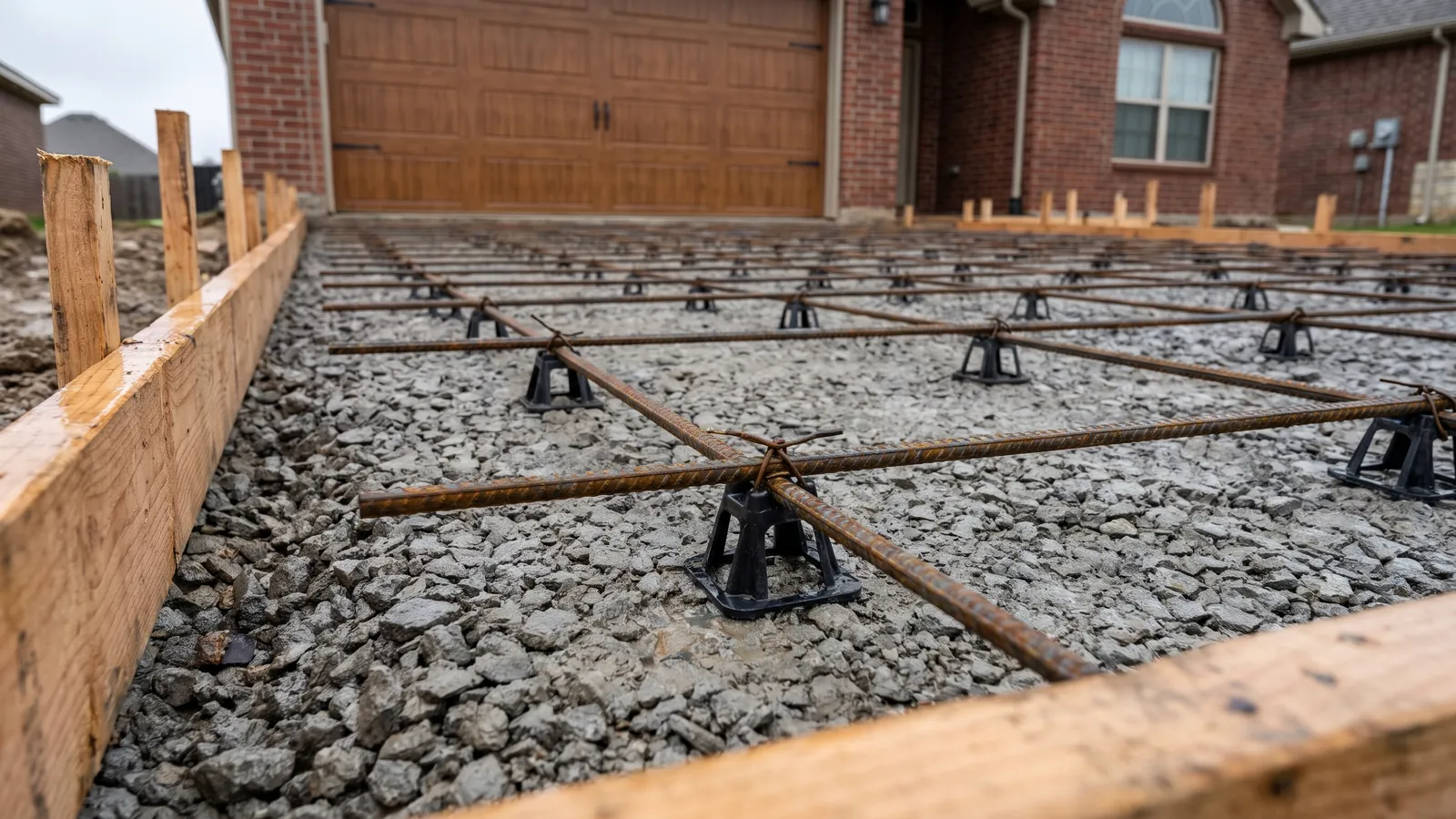
The steel goes in next, normally a grid of rebar tied at the crossings and lifted on plastic chairs so it sits near the middle of the slab once the concrete is placed. Rebar lying on the dirt does almost nothing. Along the garage we add dowels or an isolation joint against the existing slab, and at the street we tie into the approach or the curb the way the City or County permit calls for. Thickness is usually four to five inches for cars and six where a work truck, trailer or RV will park.
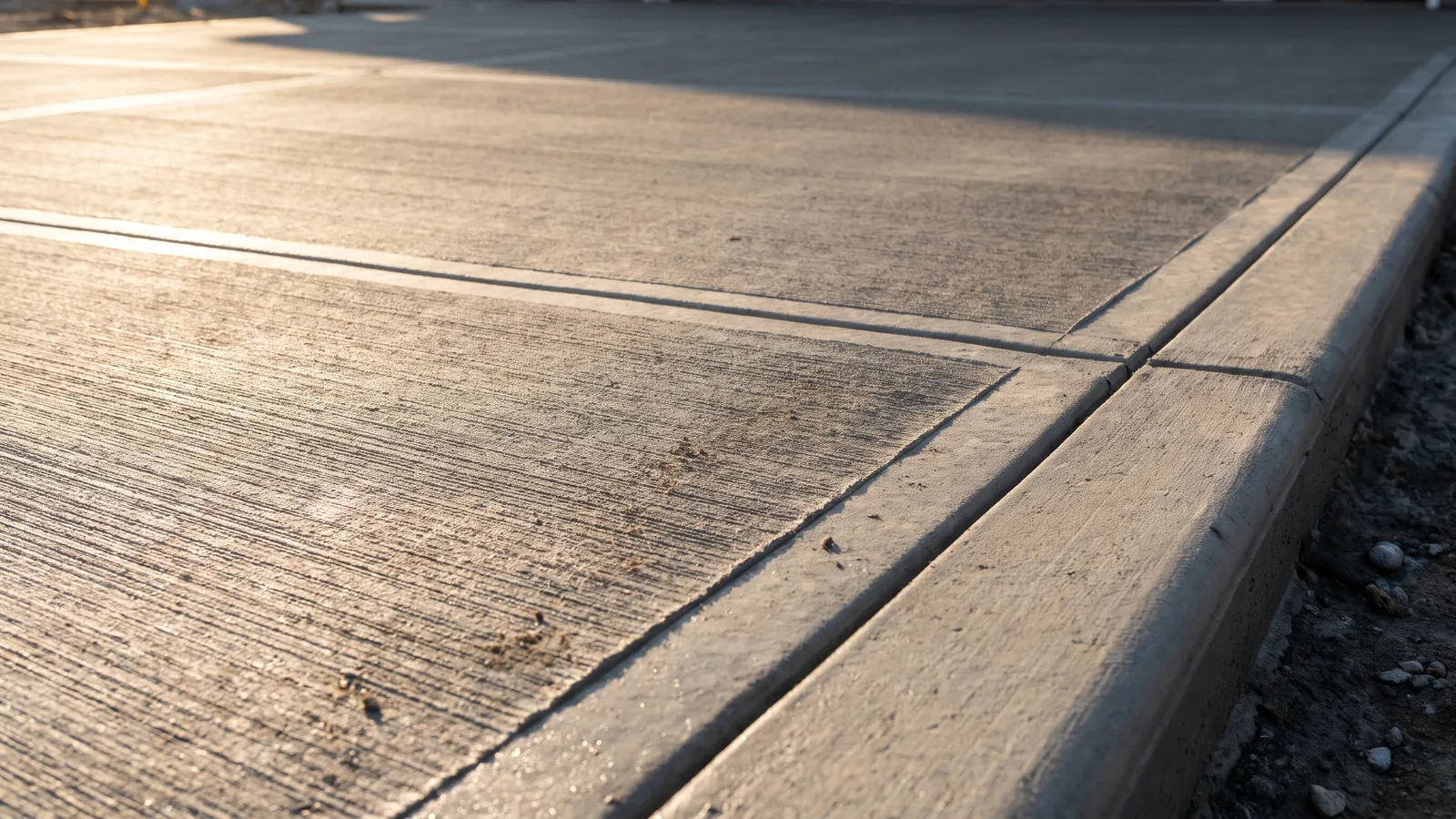
On pour day the crew places, screeds and floats the concrete, puts on a broom finish for grip in the rain, tools the edges, and cuts control joints with a saw within hours, before the slab shrinks enough to choose its own crack lines. In summer we start early, use an evaporation retarder and a curing compound, and keep the surface from drying out ahead of the concrete underneath. You can walk on it the next day and park on it in about a week.
What the job includes
Tear-out and haul-off
The old driveway broken up, loaded out and taken to a concrete recycler, with the subgrade cleaned to firm soil.
Compacted crushed base
Spread in lifts and compacted to an even, firm bed, with soft or organic spots dug out first.
Rebar on chairs
A tied grid lifted into the slab, plus dowels or isolation joints where the drive meets the garage and the approach.
Joints cut on time
Saw-cut control joints laid out before the pour and cut within hours, spaced for the slab's thickness.
Finished for rain
A broom finish across the slope for grip, tooled edges, and a fall that sends water to the street or the yard.
Permits for the approach
City of Houston or Harris County permits for approaches, curb cuts and culverts pulled for the address.
Concrete driveways prices in Houston
| Item | Typical 2026 range | Notes |
|---|---|---|
| New broom-finish driveway, 4–5 in, rebar | $8 – $13 per sq ft | Includes base, steel, joints and finish |
| Heavy-duty driveway, 6 in | $10 – $15 per sq ft | Trucks, trailers, RVs |
| Tear-out and haul-off of old concrete | $2 – $4 per sq ft | More for thick or heavily reinforced slabs |
| Typical two-car driveway, about 600 sq ft, replaced | $6,500 – $11,000 | Removal, base, rebar and finish |
| Driveway approach at the street | $1,500 – $4,000 | Depends on width, curb and culvert |
| Culvert pipe under the approach | $900 – $2,500 | Size set by the City or County |
| Exposed-aggregate or stamped upgrade | + $3 – $10 per sq ft | See stamped concrete |
These are Houston-area budgeting ranges for 2026, not quotes. Your price comes on a free written estimate after we measure, with each line itemized.
What a driveway estimate from us lists
- Square footage measured on site, and what's being removed
- Excavation depth and the base material and thickness
- Slab thickness, the rebar size and spacing, and the chairs
- Joint layout and where the new slab meets the garage and the street
- Finish, edge detail and any upgrade
- Permit, culvert and approach work as separate lines
- Cleanup, haul-off and when you can drive on it
On the job
Questions about concrete driveways
How thick should a driveway be in Houston?
Four inches is the floor for cars, and we usually recommend five on clay for the extra stiffness. Six inches makes sense where a loaded pickup, a trailer or an RV parks, and at the approach where garbage and delivery trucks turn in.
Rebar or wire mesh?
Rebar on chairs for driveways. Welded wire mesh tends to get stepped into the dirt during the pour and ends up at the bottom of the slab, where it does little. Fiber added to the mix helps with surface shrinkage cracking but doesn't replace steel.
When can I drive on my new driveway?
Walk on it after a day, drive a car on it after about seven days, and keep heavy trucks off for closer to four weeks. Concrete keeps gaining strength for about 28 days.
Will my new driveway crack?
Some cracking is normal in concrete, and on Houston clay it's a when, not an if. The joint layout is there so the cracks happen in the saw cuts. Base, steel and drainage keep the panels from breaking apart or dropping.
Can you widen my driveway instead of replacing it?
Yes. We cut a clean edge, drill and epoxy dowels into the old slab, and pour the extension with an isolation joint. The new concrete will be lighter in color than the old for a while; widening at the street may need an approach permit.
Do you handle the permit at the street?
Yes. In the City of Houston, residential driveway work in the right-of-way is permitted through Houston Public Works, with plan review and inspection. In unincorporated Harris County, the County Engineering Department permits driveways and culverts. We file it and show it as its own line on your estimate.